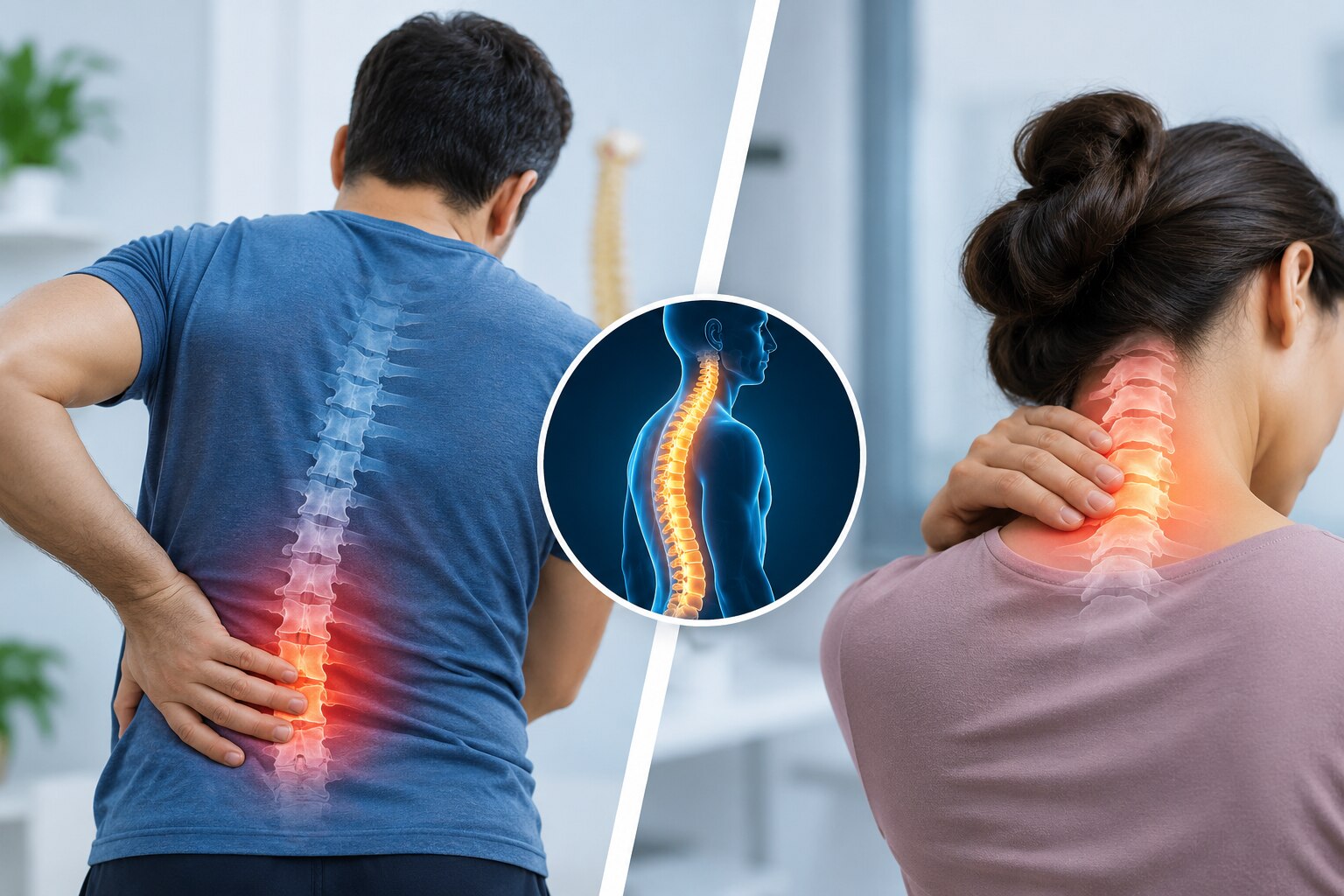
Back or neck pain can come from a strained muscle, an irritated nerve, a narrowed spinal canal, a fracture, or an inflammatory condition. By the end, you will be able to match common symptom patterns to the right level of care, recognise emergency warning signs, and understand what a spine consultation and scan can add.
Key takeaways
- Seek assessment for nerve-pattern pain, walking limits, or pain after minor trauma.
- Treat new weakness, loss of bladder control, or saddle numbness as urgent warning signs.
- Start with a qualified clinician who can examine your spine and neurological function.
- Choose MRI, CT, or X-ray based on the suspected problem and treatment decision.
Which back problems commonly need a spine assessment?
A spine assessment is justified when back pain follows a nerve pattern, limits walking, appears after minor trauma, or has inflammatory features rather than behaving like a simple strain.
| Problem | Symptom pattern | Why assessment helps |
|---|---|---|
| Muscle strain or mechanical low-back pain | Local aching after lifting, awkward movement, or overuse; movement may hurt without leg symptoms | Examination can guide activity changes and exercise-based rehabilitation |
| Lumbar disc herniation | Back pain with pain, tingling, numbness, or weakness extending into the buttock or leg | A normal X-ray does not show a herniated disc or nerve compression |
| Sciatica | Lumbosacral nerve-root irritation or compression causes pain travelling below the buttock into the leg, sometimes with tingling, numbness, or weakness | Back pain alone is not sciatica; weakness or persistent leg symptoms need review |
| Spinal stenosis | Leg heaviness, pain, numbness, or weakness brought on by standing or walking and eased by sitting or bending forward | This neurogenic claudication pattern can require targeted treatment |
| Degenerative disc disease | Gradual, activity-related back stiffness or pain that keeps returning | Assessment can separate disc changes from other pain sources |
| Vertebral compression fracture | Sudden focal pain, height loss, or a new stooped posture after a minor fall, especially with reduced bone strength | Do not dismiss these signs as muscle strain |
| Inflammatory back pain | Gradual onset before age 40, night pain, prolonged morning stiffness, and improvement with exercise rather than rest | Inflammatory disease deserves assessment even when an X-ray is normal |
Which neck symptoms point beyond an ordinary muscle strain?
A sore, tight neck after prolonged screen use often reflects posture-related neck pain or cervical muscle strain. Whiplash can cause similar local stiffness after a sudden impact. Cervical spondylosis causes age-related wear in the neck, while a cervical disc herniation can irritate or compress a nearby nerve.
| Pattern | What it suggests | What to do |
|---|---|---|
| Local aching, stiffness, or tenderness without arm symptoms | Muscle strain, posture-related pain, whiplash, or cervical spondylosis | Arrange review if it persists, recurs, or limits sleep and work |
| Shooting, burning, tingling, numbness, or weakness travelling from the neck into an arm or hand | Cervical radiculopathy from nerve-root irritation, sometimes caused by a cervical disc herniation | Seek clinical assessment, especially if grip or strength is reduced |
| Clumsy hands, loss of fine motor control, gait imbalance, falls, leg stiffness, or bladder changes | Cervical myelopathy, meaning spinal-cord compression | Seek expedited medical evaluation |
Symptoms that spread into the hand or reduce grip are not the same as a tight neck after screen use. Most cervical radiculopathy improves without surgery, but objective weakness or weakness that is getting worse requires clinical review.
Do not use high-velocity neck manipulation as a substitute for neurological assessment when symptoms are severe, unusual, or spreading. Sudden limb weakness, facial droop, speech difficulty, or severe dizziness with neck pain requires emergency care.
When should you stop home care and seek urgent help?
Book a spine clinic consultation when pain lasts more than a few weeks, keeps returning, wakes you at night, limits work or sleep, reduces walking or hand function, or fails to improve with sensible activity modification and exercise-based rehabilitation.
Clumsy hands, worsening grip, gait imbalance, falls, or leg stiffness need expedited assessment because they can indicate cervical spinal-cord compression.
Treat these back pain red flags as emergencies:
- New loss of bladder or bowel control
- Inability to urinate or new urinary retention
- Numbness around the groin, genitals, or anus
- Rapidly worsening weakness
- Weakness in both legs
- Inability to walk
- Major trauma
- Severe back pain with fever
These symptoms can indicate cauda equina syndrome, which requires immediate emergency evaluation rather than waiting for a routine appointment.
Seek prompt medical assessment for persistent pain with unexplained weight loss, a recent serious infection, immune suppression, or intravenous drug use. Fever is not required for a spinal infection, so do not dismiss persistent severe pain because your temperature is normal.
Neck pain red flags include sudden facial droop, speech difficulty, one-sided limb weakness, or severe dizziness with unusual neck pain. Go to emergency care rather than having neck manipulation; stroke or cervical artery dissection must be considered. Do not use high-velocity neck treatment as a substitute for neurological assessment.
Which clinician should you see, and what happens at the first visit?
Choose the emergency department for new bladder or bowel control loss, urinary retention, numbness around the groin or anus, rapidly worsening weakness, weakness in both legs, inability to walk, major trauma, or severe pain with fever.
Sudden facial droop, speech difficulty, one-sided weakness, or severe dizziness with unusual neck pain also needs emergency assessment, not neck manipulation.
| Option | What it means | When it applies |
|---|---|---|
| Spine clinic | Focused spinal assessment | Persistent or recurring pain, radiating symptoms, weakness, gait change, or suspected structural disease |
| Orthopaedic clinic | Bone, joint, and musculoskeletal evaluation | Back or neck pain after injury, suspected fracture, or ongoing mechanical symptoms |
| General physician | Broad medical assessment | Fever, weight loss, other medical symptoms, or uncertainty about where to start |
| Neurologist | Nerve and spinal-cord evaluation | Clear neurological findings, such as progressive weakness, sensory loss, clumsy hands, or balance problems, when referral is appropriate |
| Physiotherapist | Movement and rehabilitation care | Movement-related pain after serious causes have been excluded |
At the first visit, expect questions about onset, injury, pain distribution, night symptoms, numbness, weakness, bladder or bowel changes, fever, weight loss, and previous treatment. The clinician then observes posture and movement and checks strength, reflexes, sensation, and gait.
Those findings determine whether you need imaging, blood tests, rehabilitation, or referral. For Pune residents, Vivaan General Care And Orthopaedic Clinic offers a practical starting point for non-emergency general medical and orthopaedic evaluation, with physiotherapy-related care considered when clinically appropriate.
When do X-ray, MRI, or CT change the treatment plan?
Most new low-back pain is nonspecific mechanical pain, so routine imaging is not recommended when there are no red flags and the result is unlikely to change management. A scan becomes useful when symptoms persist, progress, suggest serious disease, or point to a problem requiring different treatment.
- X-ray for back pain shows bones, spinal alignment, fractures, and some degenerative change. It does not directly show a herniated disc, spinal cord, or most nerve tissue, so a normal X-ray does not rule out nerve-root compression.
- MRI for sciatica is generally preferred when radicular symptoms persist or worsen, or when clinicians need to assess spinal-cord compression, infection, malignancy, or a complication of fracture. MRI shows discs, nerves, the spinal cord, soft tissues, and bone marrow.
- A CT scan of the spine produces detailed bone images. Use it when complex fractures need assessment, MRI is unsuitable, or bone detail is the priority.
Disc bulges, arthritis, and disc degeneration are common in people without pain. These incidental imaging findings identify the pain source only when they match your symptoms and examination.
Acute sciatica often improves over several weeks to a few months. Keep moving within tolerable limits; prolonged bed rest is not recommended. Injections are not a universal back-pain treatment, and surgery is reserved for selected persistent disabling cases or urgent neurological compromise such as progressive weakness or cauda equina syndrome.
Frequently asked questions
Which back problems commonly need a spine assessment?
Arrange a spine assessment when pain follows a nerve pattern, limits walking, follows minor trauma, or has inflammatory features instead of behaving like a simple strain.
Which neck symptoms point beyond an ordinary muscle strain?
Neck pain needs assessment when it causes arm pain, tingling, numbness, weakness, balance problems, or other signs of nerve or spinal cord involvement.
When should you stop home care and seek urgent help?
Seek urgent help for new limb weakness, loss of bladder or bowel control, saddle numbness, severe pain after significant trauma, fever with spinal pain, or trouble walking.
Which clinician should you see, and what happens at the first visit?
Begin with a general physician, orthopaedic clinician, or spine specialist. The first visit usually includes a history, spine examination, neurological checks, and a treatment plan.
When do X-ray, MRI, or CT change the treatment plan?
X-rays show bones and alignment, MRI shows discs, nerves, and the spinal cord, and CT provides detailed bone images. Choose testing when results will guide treatment.
Keywords